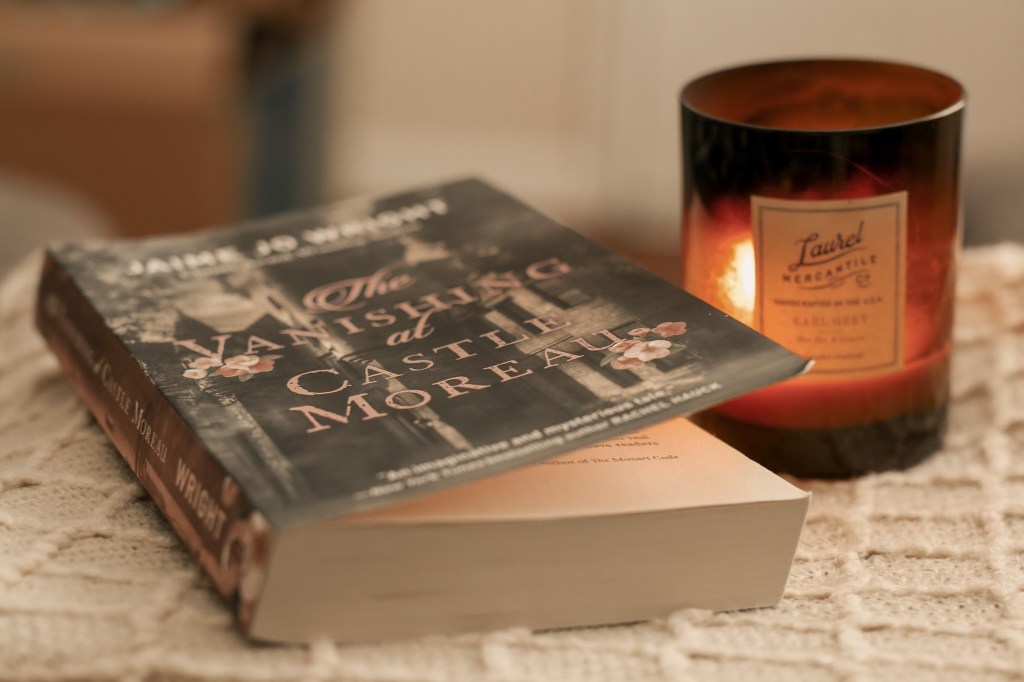
Genre: Christian Mystery and Suspense
Format: Paperback
My rating: 5 out of 5 stars
Reasons to love:
-Split timeline
-Castle
-In love with the boss
-French ties
-Secret rooms and passageways
-True crime podcaster
-Cold case
-Protective MMC
-Strong characters with disabilities
Cautions: content: This is one of Wright’s milder books—there’s not as much overt dark behavior and whether there’s been a murder is one of the main questions the reader seeks to answer. Just like the mystery of a castle with hidden passages, the main issue Wright highlights in this book is the often hidden and difficult under-discussed nature of domestic violence. She does not go into detail, but the topic does appear throughout the book. It’s more mystery than a murder mystery; there were a couple of kisses and romantic moments, but very little spice
Main themes: Family, justice, survival, sanctuary
Main characters: Daisy Françios, Lincoln Tremblay, Cleo Clemmons, Deacon Tremblay, Ora Moreau-Tremblay, Virgie Tremblay, Elsie Stockley, Dave, Stasia, Festus
Favorite quote: “You realize that if you aren’t an ambassador for your own feelings and thoughts, then no one else shall be either?”
Review:
Have you ever experienced a moment, whether good or bad, where the barrier between the spiritual realm and the material world seemed to evaporate? Maybe chills danced across your skin, and you checked over your shoulder to see who might be following—only to find an empty street. Or maybe you walked into an abandoned house and immediately felt uneasy, then noticed the drawings of symbols and death-focused poems scribbled on walls with peeling paint.
If you’ve ever experienced the above or anything similar, you know the questions that rage through your mind like wildfire: What was that? Did I really see someone? Was it my sleep-deprived mind and bleary eyes or did that really happen? How can I explain the chills, the feeling of being watched, the voice deep in my bones that said run?
And you know, for some of these questions, there’s a logical answer. That’s one of the things I love most about Jaime’s books. Though The Vanishing at Castle Moreau was a little less “spiritual” than many of Jaime’s other books, the suspense, the wondering about what you saw or if your eyes have betrayed you, exists in spades.
Unlike Jaime’s other works, Vanishing actually began with a third perspective, so it wasn’t the opening line that grabbed my attention, it was the opening perspective of a little girl living within the bounds of Castle Moreau. The fear of death and things unknown felt palpable from the perspective of a child, and getting to see her grow throughout the book was such a treat. Though I won’t name her for my own fear of spoiling the story for you.
As per usual, Jaime quickly drew me into each piece of the story through her historical heroine, Daisy, and her modern-day heroine, Cleo. For different reasons, both women unwittingly sought refuge in Castle Moreau, whose dark and imposing structure from the outside seemed the stuff of ghost stories and mystery rather than safety.
Throughout both storylines, we’ll see our heroines struggle with the idea of what’s right and wrong and who to go to when your sense of trust has been damaged. We see them heal and hope and question and break and repeat the cycle all over again—all the while growing in strength and finding a place to belong at Castle Moreau. And maybe a place beside the men who stand as protectors of the Moreau-Tremblay name and all that it means.
Our heroines are surrounded by two spunky, eccentric older women—Ora and Virgie—from the Moreau-Tremblay lineage. In them, we see how history changes us, how it takes its toll, and how nothing is what it seems from the outside, whether it’s the way people view us because of the body we have or the walls we’re protected by. And there’s just a delicious mix of my love for writing and reading mystery as well as my love for true crime podcasts (heyo, Stasia). Even the characters with the dark, brooding, and mysterious set to their jaws endeared themselves to me. All the characters did. Except Dave. Oh, Dave was a necessary part of the story, and I could understand him in some ways, but he just . . . got under my skin. And I think that was intentional in his design. (If you’ve read this, I wonder if you can relate?)
The mysterious nature of the matriarchs of Castle Moreau, the wounded heroes, and the haunted heroines contributed to the feel of the dark, damp, and complex feel that I imagine lined Castle Moreau’s halls (alongside the boxes and items Virgie had begun to hoard). I mean, really, all you had to say is that the setting was a castle in the middle of America and my curiosity was piqued. Once again, the mood, the characters, and the setting described in Jaime’s captivating prose built a tale as unique and mysterious as the castle itself.
And one of the things I’ve grown to love about Jaime’s writing is how she calls attention to some issue that should deeply move us, and in a way, shows us that we all have the capacity to be heroes in someone else’s story. I don’t want to give too much away, but thank you, Jaime for shedding light on the oft-hidden nature of domestic abuse in this story.
Turning the last page was a sigh of relief and a heavy goodbye to more characters I’ve grown to know and love over the course of 371 pages. My heart was broken and full all at the same time. Every book almost seems to end with a call to action, though not obvious in word, it echoes in my heart.
My take:
People build walls to hide—for safety, for security, for peace, to create space to exist in a world that rejects them. But we need each other. We need people who will scale those walls, take us by the hand, and walk a silent sentries beside us. Sometimes we’re the hand that guides and sometimes we’re the hand that grips tightly, holding on for dear life to hope.


Leave a comment